Software Insights · Newsletter
No opinion without evidence. No finding without a source.
Peer-reviewed software engineering research, translated into clear, actionable guidance for engineering leaders.
Subscribe on Steady →Weekly · Free
Archive The capability you cannot fork: software’s break with universal accessAI in SE
 Europe is about to make human-first software non-optionalAI in SE
 Ericsson’s AI-native software programme: principles, deployment, and open questionsAI in SE
 Disarm AI, Re-Arm Teams: Two Levers Against a Lost CohortAI in SE
 Three years of AI: what the evidence settles, contests, and leaves unmeasuredAI in SE
 A Bad Benchmark Does More Damage Than No Benchmark at AllResearch Methods
 Cleaner Code, Foggier Teams: The Debt AI Moves UpstreamAI in SE
 The Composition Trap: Why Agent-Dense Teams Break in Ways Human Teams Never DidAI in SE
 Your Agents Pass Every Test. Your System Can Still Fail.AI in SE
 Cutting the Junior Pipeline Before the Automation ArrivesAI in SE
 AI Can Solve Your Benchmark. Can It Fix Your Codebase?AI in SE
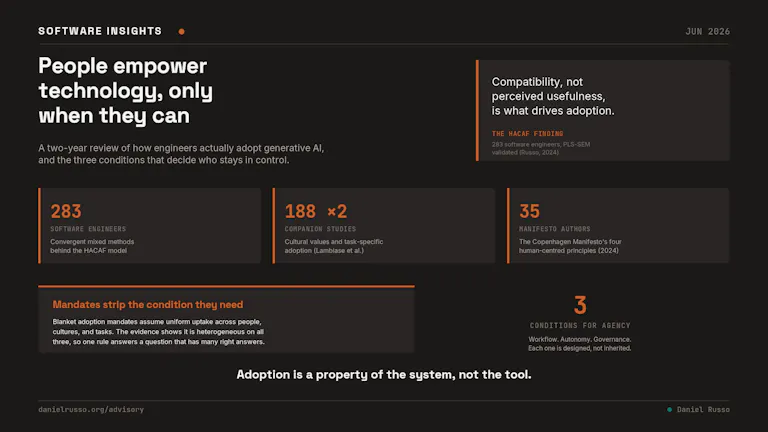
 56% of Organizations Get Nothing from AI Because Compatibility Was an AfterthoughtAI in SE
 The New Engineering Judgment: Five Skills That Survive the Agentic TransitionDeveloper Productivity
 When Code Becomes the Output: Rethinking What We Teach (and Hire For)AI in SE
 Speed at the Cost of Quality: The Hidden Tax of Agentic AIAI in SE
 The “Country of Geniuses” Requires a Constitution, Not Just a LoginAI in SE
 Davos 2026: From “Chat” to “Work”Agile & Process
 Europe’s Tech Renaissance Beyond the “Kill Switch” NarrativeAI in SE
 Technological Sovereignty in a New Era: A Compass for Europe’s Digital FutureAI in SE
The capability you cannot fork: software’s break with universal accessAI in SEEurope is about to make human-first software non-optionalAI in SEEricsson’s AI-native software programme: principles, deployment, and open questionsAI in SEDisarm AI, Re-Arm Teams: Two Levers Against a Lost CohortAI in SEThree years of AI: what the evidence settles, contests, and leaves unmeasuredAI in SEA Bad Benchmark Does More Damage Than No Benchmark at AllResearch MethodsCleaner Code, Foggier Teams: The Debt AI Moves UpstreamAI in SEThe Composition Trap: Why Agent-Dense Teams Break in Ways Human Teams Never DidAI in SEYour Agents Pass Every Test. Your System Can Still Fail.AI in SECutting the Junior Pipeline Before the Automation ArrivesAI in SEAI Can Solve Your Benchmark. Can It Fix Your Codebase?AI in SE56% of Organizations Get Nothing from AI Because Compatibility Was an AfterthoughtAI in SEThe New Engineering Judgment: Five Skills That Survive the Agentic TransitionDeveloper ProductivityWhen Code Becomes the Output: Rethinking What We Teach (and Hire For)AI in SESpeed at the Cost of Quality: The Hidden Tax of Agentic AIAI in SEThe “Country of Geniuses” Requires a Constitution, Not Just a LoginAI in SEDavos 2026: From “Chat” to “Work”Agile & ProcessEurope’s Tech Renaissance Beyond the “Kill Switch” NarrativeAI in SETechnological Sovereignty in a New Era: A Compass for Europe’s Digital FutureAI in SEThe newsletter covers the evidence. When a question needs that evidence applied inside a specific organisation, that is what the advisory work is for.
by Daniel Russo, Ph.D.